One Agent, Six Countries: What Napster Learned on the AI Events Circuit in September


In September, Napster's agents worked rooms around the world, from Riyadh to London, New York, Amsterdam, Toronto, and Sri Lanka. The agent looked different at almost every stop. In New York, it was Jack, the ticketing concierge for the Formula 1 Belgian Grand Prix. In Sri Lanka, it was Kito, a national telecom provider's customer agent, rebuilt as a conversational video experience. In Toronto, it was a Napster Station kiosk that came for a demo and stayed.
The face changed from city to city. But beneath it, the experience held steady: one agent that moves between a phone, a webpage, a kiosk, and an app, all without losing context.
Napster calls that an omniagent, and it’s what we think the future of agentic AI looks like. Here’s how people reacted, what stood out at the events, and what we learned from watching people in conversation with an agent that doesn’t forget them.
Continuity is what makes an agent feel like a relationship
Most customer journeys break at the handoff. Someone starts in a website chat, calls support an hour later, and walks into a store two days after that. Each surface usually starts from zero, and the customer repeats themselves every time.
At Kinly Inspire in London, Napster SVP of Partnerships and Ecosystems Ati Serpoushan and her team showed off an omniagent that fixes the handoff problem. The same agent carries the same memory from surface to surface, so a returning customer is recognized rather than treated as a new visitor. If a human needs to be brought into the loop, they’re provided with a full rundown of the agent’s interactions so far so they don’t miss a beat. Continuity creates familiarity, and familiarity makes the interaction feel more like a relationship.
At HumanX in Amsterdam, Napster CEO John Acunto made the commercial case for the same idea.
“That’s really what those agents are there for,” he said. “They’re there to memorize your website, memorize what you're trying to do, and to distribute your message in a way and with the personality you want it delivered with.”
Persistent memory is what turns a good conversation into a lasting one. An agent that forgets the customer between surfaces is several agents sharing a name.
Proof has to be visible
At the Fast Company Innovation Festival in New York, Napster CPO Ziv Navoth took the stage with Julien Lalmand of Spa Grand Prix to prove that customers not only engage with AI with a face, but prefer it to a static web experience. That proof came from a new case study Napster shared onstage: In its first 60 days on the Belgian Grand Prix ticketing site, Jack held more than 55,000 conversations in 21 languages, improved clickthroughs to checkout by 70%, and drove an anticipated $623,000 in incremental revenue.

The results put numbers behind the argument that conversational AI is not just more engaging, but more effective than traditional chatbots in driving business outcomes and improving customer experiences.
“It’s proven you can use an AI agent in order to provide customers with support in very complex decision-making situations, such as buying a high-ticket item to an event with a lot of variables,” Navoth said. “Agents have arrived, and they are welcomed by a lot of customers.”
Most conversations about AI still stop at capability. A revenue figure on a screen moves the conversation to the thing a buyer actually needs to know.
Toronto made the same argument with hardware. Napster brought Station to the Microsoft Innovation Hub for a demo day and left it there as a permanent installation. The kiosk's job is to let people walk up, interact with it, and see for themselves how physical AI can help them navigate a space. It’s the real-world component of Napster’s end-to-end AI ecosystem: the agent a customer meets on a website can greet them in a lobby, on the same platform and with the same memory.
Outside the US, the brief is "build here, for here"
In New York, the AI conversation centered on return on investment. In Riyadh and Sri Lanka, the buyer was often a national institution, and the mandate was building local capability.
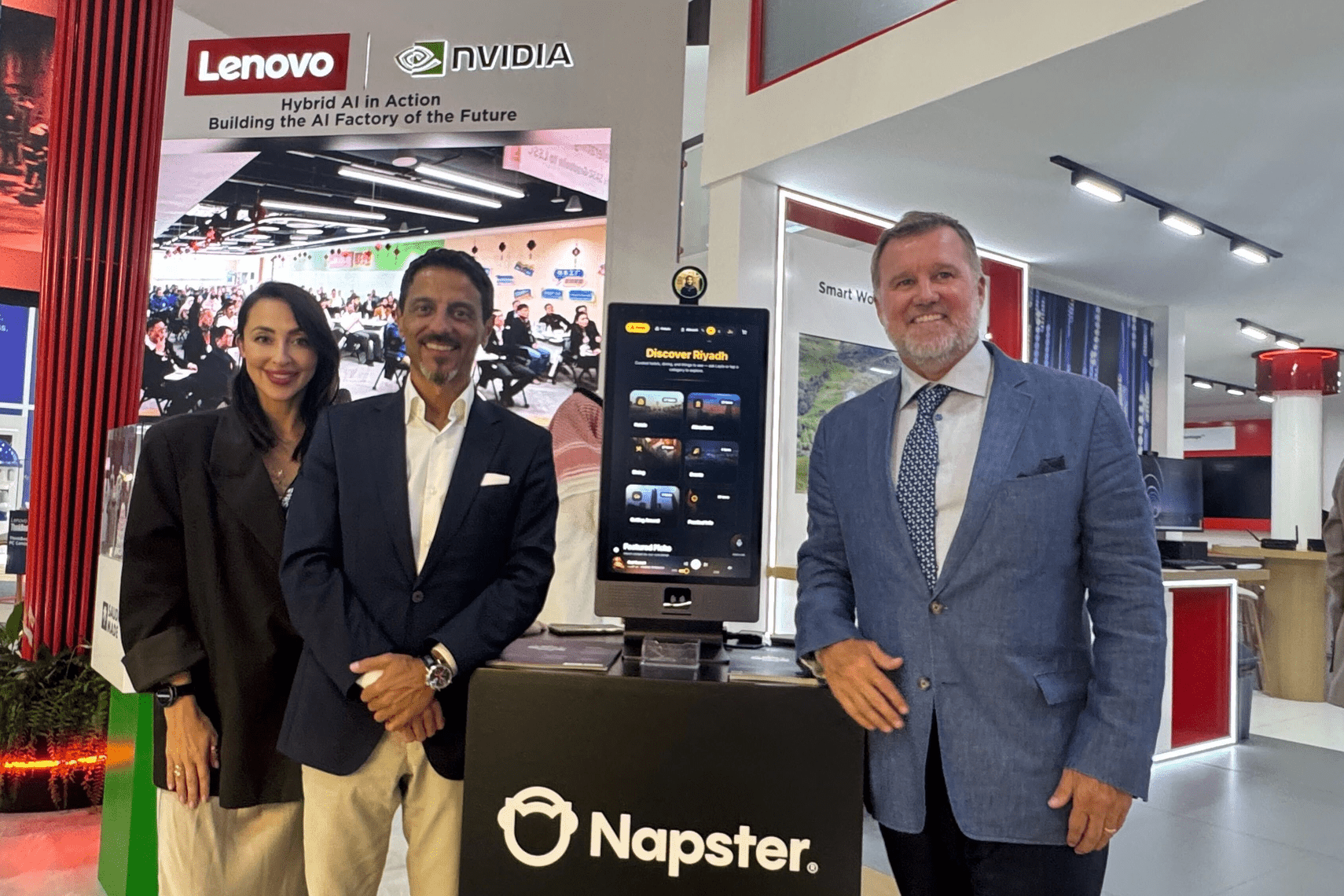
At LEAP in Riyadh, Napster announced its incorporation in Saudi Arabia after a year of building relationships in the market. Frank Furnari, Napster's General Manager for Saudi Arabia and SVP, argued that what separates AI companies entering the region is how closely they align with the market’s distinct needs.
“You need to think about the whole chain,” he said. “You need to have the infrastructure in place … but one of the key elements here, it’s people.”
Sri Lanka showed what that alignment looks like on the ground. SLTMobitel, the country's national telecom provider, invited Napster to share its booth at the National AI Conference & Expo during Sri Lanka AI Week from Sept. 25-30. On display was Kito, SLTMobitel's customer agent, which Napster transformed from a chatbot into a conversational video experience. Notable guests included Minister and Leader of the House Bimal Rathnayake and SLTMobitel Chairman Mothilal De Silva, who visited the booth to see the agent in action.
The omniagent architecture is what makes that kind of localization possible at global scale. The platform stays consistent, while the persona belongs to the market it serves.
Six countries, one big lesson
Across a half-dozen use cases all over the world, Napster found one commonality: The relationship layer of AI is what takes this technology to the next level. People want an agent that knows them wherever they meet it. Moreover, they want proof it works before they commit and they want it built for the place they live.
Napster's agent wore a different face in every city this month. The memory underneath traveled with the customer. That is how an omniagent democratizes access to expertise, one surface at a time.
To see what an omniagent can do for your customers, explore the Napster API or contact our team.
Related posts
Stay up to date with the latest platform updates, feature launches, and important news.




Press inquiries.
Journalists and media professionals can contact our team for interviews, information, or additional materials.