The Business World of Tomorrow Belongs to AI – and Humans
At LEAP 2026 in Saudi Arabia, Frank Furnari, general manager for Saudi Arabia and senior vice president at Napster, spoke about the future of AI in the workplace, where humans work together with AI agents. He advised entrepreneurs to “focus on the problem and then use all the technology available today and in the future to actually solve that specific problem.”

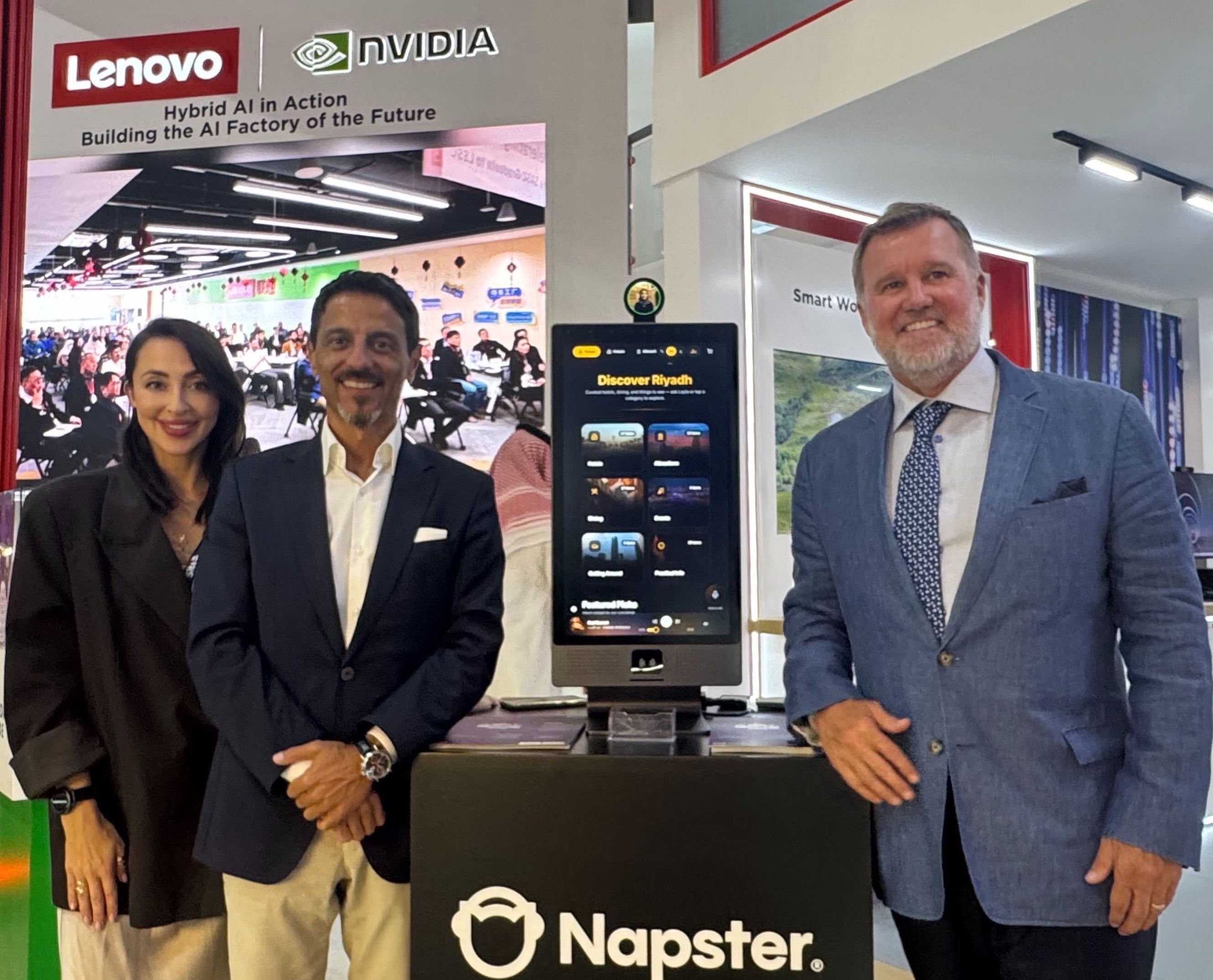
While sharing learnings from LEAP 2026, Napster makes the case that AI agents aren't replacing employees: They're becoming coworkers, and they're only useful to us if we work with them to problem-solve together
At LEAP 2026, Frank Furnari, general manager for Saudi Arabia and senior vice president at Napster, sat down with Business Today Middle East to do a little future-casting. The company of tomorrow, Furnari said, will not be defined by a fixed headcount of human employees. It will be an “agile” combination of human employees and digital employees, working side by side.
The way Furnari and Napster see it, this will be a pretty natural escalation. He compares AI to electricity: something that started as a marvel and a competitive edge, and is now a commodity and part of a company’s assumed infrastructure. Success belongs to whoever builds the most useful things on top of it.
AI and people — working together.
Napster’s work in Saudi Arabia over the past year led to a critical moment at LEAP, Saudi Arabia's flagship tech and AI conference, when the company announced its incorporation in the Kingdom. The news followed a year of relationship-building and commitment to serving Saudi businesses as more than an AI services vendor.
What separates one AI company from another in the Saudi market, Furnari said, is not the technology. It is how closely it aligns with what the market actually needs, and only people who are close to the market can make that judgment call. The infrastructure runs itself. The alignment does not.
“The infrastructure that Saudi Arabia is building here, it’s not for today or tomorrow, but it’s going to last 10, 20, 50 years. But then you need them empowered to actually capitalize on that infrastructure,” Furnari said. He adds that the key element here is “people. People to enable, people to have those skills, to have those open minds, to actually capture an implement and capture reality. … It’s a human resource to actually embrace this technology and take this technology to the next level.”
A human employee's contribution is shaped by skills and education, and it changes as both develop. Furnari argued agents will follow the same arc, evolving over time. The useful model, and the one Napster is building toward, is an employee on a growth trajectory, working alongside human colleagues rather than replacing the need for them.
Why humans drive the change
Furnari's read on Saudi Vision 2030 shows what happens when that human judgment gets skipped. Vision 2030 gets invoked constantly as shorthand for opportunity, a signal that the market is open and the appetite is real. He does not dispute that, but he is direct about what Vision 2030 actually is: “a framework,” not a guarantee. An AI platform that is not built with that human oversight baked in will not succeed.
“It’s primarily who is going to embrace everything that the Saudi market wants and provides at the same time,” he said.
That same instinct, technology in service of people rather than the other way around, shapes his advice to entrepreneurs. Don’t focus on what the technology can do right now, he said, because that list is already out of date by the time you have built around it. Instead, “think outside the box” about the actual problem you are trying to
solve, and only then reach for whatever combination of technologies gets you there.
He advised entrepreneurs to “focus on the problem and then use all the technology available today and in the future to actually solve that specific problem.”
But, he said, be careful about complexity. Solve the problem, but solve it “in a simple user-experience way.” Complicated interactions do not get adopted; they get abandoned. The bar is not just usefulness. It is usability, and usability is ultimately a question of how well an agent works for the human on the other side of it.
AI and human thought leadership leading the way
Agents are best understood not as software but as digital colleagues who have their own learning curve. And none of it works without people willing to build the skills to work alongside that curve. It’s not a matter of humans or agents. It is humans and agents, each doing what they do best, collaborating to meet challenges as a team.
For a market building at Saudi Arabia's scale and speed, that is not a talking point. It is the operating model.
“Basically, it’s a combination of human employees and digital employees,” Furnari said. “So, if you ask me what the future of companies will look like, it’s going to be this company that’s made up of human, real employees with digital employees. And the combination of the two actually creates the company of that moment.”
Related posts
Stay up to date with the latest platform updates, feature launches, and important news.



Press inquiries.
Journalists and media professionals can contact our team for interviews, information, or additional materials.