What Napster Learned on the Ground at Microsoft Build, Fortune Brainstorm Tech, and Cannes Lions

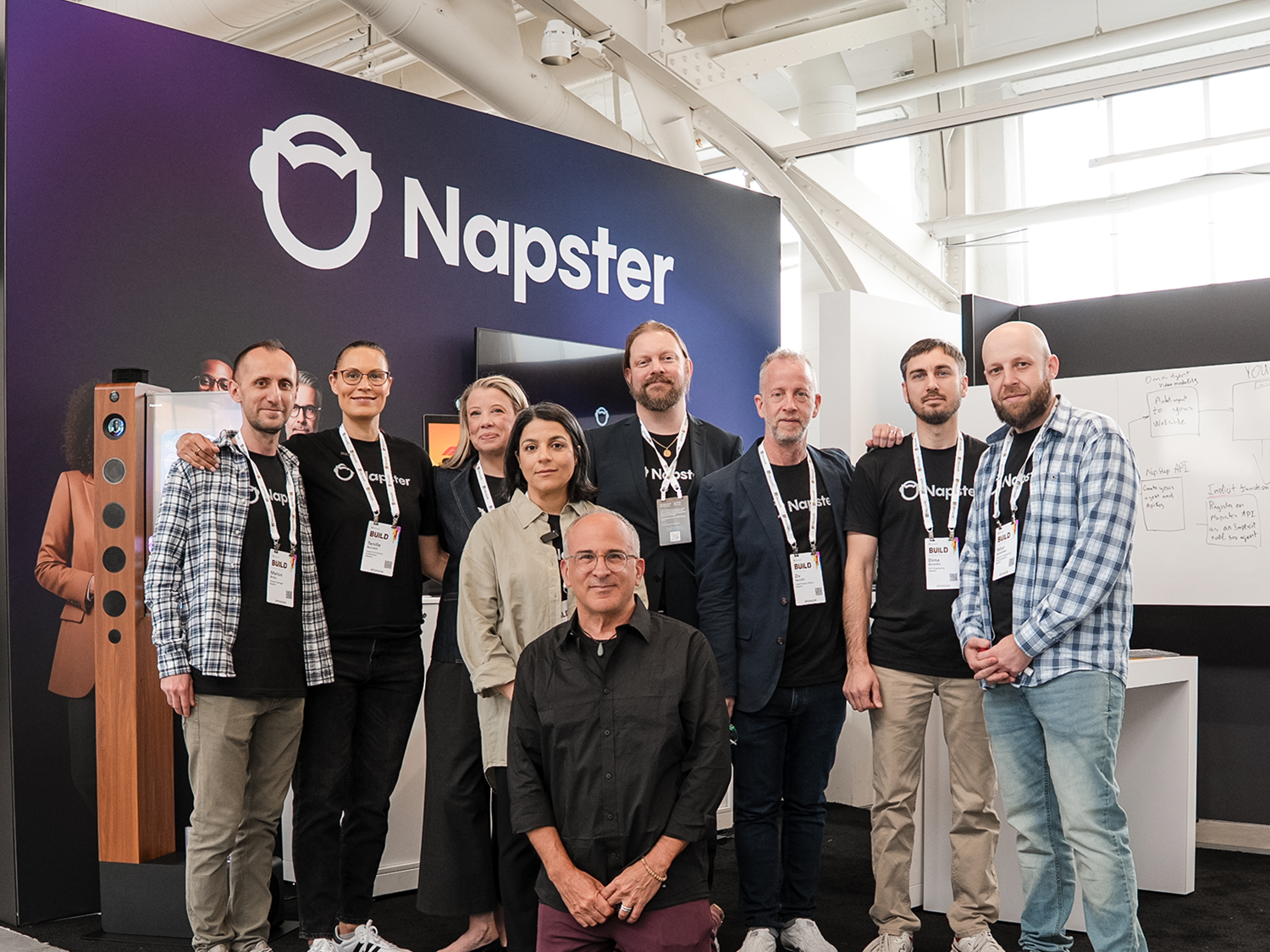
After three international events, the release of Napster API and the NV2 model, the launch of an agent for Spa Grand Prix, and much more behind the scenes, a busy June is wrapping up for Napster.
It was a rewarding month not just because of what the company deployed, but who Napster got to meet. Developers and AI architects in San Francisco. Technologists and investors in Aspen. Marketers and creatives on the French Riviera. Microsoft Build, Fortune Brainstorm Tech, and Cannes Lions draw different crowds with different priorities and a different vocabulary for talking about the AI industry, and Napster leadership was in the room for all of those conversations.
Here's what they took away.
Context, memory, and trust build ROI for AI
Microsoft's Work IQ, Scout, and an agentic infrastructure for enterprise environments were the biggest announcements at Build, and they’re all based on the same premise: Models are becoming commodities, and the real value is in contextual understanding of the people and organizations using them. One line from Microsoft's own team captured it directly:
“Agents are only as good as the context we give them.”
That theme surfaced repeatedly at Brainstorm Tech, too. One session examined why AI systems that perform in pilots collapse in production. The answer wasn't fragmented data, disconnected workflows, and context that never accumulates into anything useful. Adobe, Databricks, and Salesforce were circling the same issue at Cannes, framing agentic AI as an operating layer rather than a feature set.
AI that doesn't remember, doesn't learn, and doesn't build on previous interactions responds to the last thing you typed and nothing more. Persistent memory is the foundation that determines whether an AI system develops a relationship with a user or just generates a response. The companies that get this right earliest will be very difficult to catch.
‘Authenticity’ is the wrong word for the right problem
A Fortune/Morning Consult survey of more than 1,100 marketing and finance decision-makers found that 78% are concerned increased AI use will reduce consumer trust in their brands. A February Clutch report found that 81% of consumers “have stopped supporting a brand because it did not feel authentic.”
The “Silence, Brand” chants are getting louder in the AI era. But most companies can’t afford to fall behind by putting this technology aside entirely. So where is the middle ground? How do you create genuine connection while using today’s toolkit to the fullest?
Napster Global Head of Communications Gillian Sheldon spent the week in conversations with marketing and communications leaders, including those steeped in AI and people keeping it at arm’s length. The consensus had less to do with how much AI is used but rather where and when.
Ingenuity, creativity, and focus come out of human-led work. The final touches need to come from human hands, to ensure quality and authenticity, and to prevent silly things that can be catastrophic for your brand, like putting the wrong number of handlebars on a bike. AI has a place in the middle ground, though, where small tweaks take place and most of the drudgery of creative work comes in. It can be especially helpful when it comes to offering variations on concepts that would typically be a significant time-sink.
Messaging that is grounded in what your audience truly cares about and avoids the sameness, repetition, edge case distortions, and other hallmarks of AI will continue to make an impact. And AI can be a part of that process, as long as it too is grounded, given proper guidance, and like any junior employee can learn from its mistakes.
TL;DR: It still takes a village to create great content. People want to connect, to belong, and if your campaign gives them that opportunity, it’ll resonate – with or without AI in the mix.
What do you do once AI starts training AI?
Fortune Brainstorm Tech opened with a session framing the command line as the most important battleground in tech. AI is no longer just writing code: It's running it, using other software, and in some cases building itself. When production becomes cheap and the blank page fills itself, the advantage shifts from people who execute fastest to people who know how to direct.
Napster CTPO Edo Segal has written about this shift as the moment AI stops feeling like a tool and starts operating like a team. The developers who reached that threshold first aren't producing more of the same thing faster. They're attempting work that wasn't feasible before.
That said, industry insiders across all three events agreed most organizations aren’t ready to commit to working differently. They want faster, more efficient, cheaper. That smaller thinking is why the market has reacted to AI in the way it has, especially within tech circles.
Companies don't lack AI tools. They lack the judgment to use them well. Capability claims without proof are being called out in real time, too: Enter “pitch-maxxing,” a term coined by agency and marketing leaders at Cannes for the pattern of overselling AI chops to win business.
Getting value out of AI requires elasticity, both as individuals and as companies, and as employees reskill, so too should their employers. The Elastic Organization is one that aims its AI tools at amplification rather than replacement, and that approach can be extremely powerful. It’s a more radical, but also more realistic approach than most companies are taking with AI right now.
A few things that stuck with us
At Build: Surprise! Chainsmokers founding member Alex Pall took the stage wearing an old-school Napster hat during Microsoft’s keynote. We got him some new swag later that evening, but the impromptu throwback moment was a reminder of what Napster stands for: challenging industry norms, putting power in users’ hands, and being a bit of a rebel.
At Brainstorm Tech: Napster CPO Ziv Navoth joined one of the conference's liveliest sessions: a wide-ranging debate about what needs to be rebuilt now that AI has upended the institutions, policies, and assumptions that organized modern society. The panel touched on everything from keeping up with China’s AI development to protecting children from overreliance on AI to what we can do, in a hyper-competitive economy, to make frontier companies collaborate on safeguards for everyday people.
The panel included Graham Dugoni, founder of Yondr, who built a company on the premise that technology should sometimes be physically removed from human experience, and Eric Vaughan, CEO of IgniteTech, whose company cut 80% of its staff as part of a full-speed-ahead move toward AI adoption. The friction in the room was genuine and productive, a combination that's increasingly rare at industry events.
Ziv leaned toward the people-first take, with a focus on what the right relationship between human agency and AI capability looks like in practice. AI needs to be for everyone, and democratization of expertise needs to uplift people, not unmoor them.
At Cannes: Technology is not a strategy, and AI adoption is not a business outcome. A “proof-point gap” coupled with high-profile misfires has amplified skepticism about what AI can do for marketers, advertisers, and creatives. The organizations pulling ahead are the ones being honest about what their AI can and can't do, and building proof to match their claims.
Related posts
Stay up to date with the latest platform updates, feature launches, and important news.





Press inquiries.
Journalists and media professionals can contact our team for interviews, information, or additional materials.