Persistent Memory in AI Agents: Why Customers Shouldn’t Have to Start Over
From espresso machines to luxury retail, AI agents that remember customers turn return visits into progress instead of do-overs.

Sarah spends 20 minutes one evening with a retailer’s website agent, narrowing dozens of espresso machine options down to one. She wants to see it in-person before she buys it, so Sarah heads to the store the next morning.
At the counter, though, she has to start all over. The agent there asks about her budget and what she drinks most, the same questions she answered the night before. She re-explains her preferences and describes the model she wants, but what she expected to be a pit stop has now taken 15 minutes. She leaves, frustrated, without an espresso machine.
That experience is more common than businesses realize. In a 2026 Adobe survey of 1,002 consumers, 55% said they avoid brands that make them re-enter information when switching channels. Yet most AI agents don’t retain information between sessions, let alone carry context from one platform to another. That’s the problem persistent memory in AI agents solves.
What is persistent memory in AI agents?
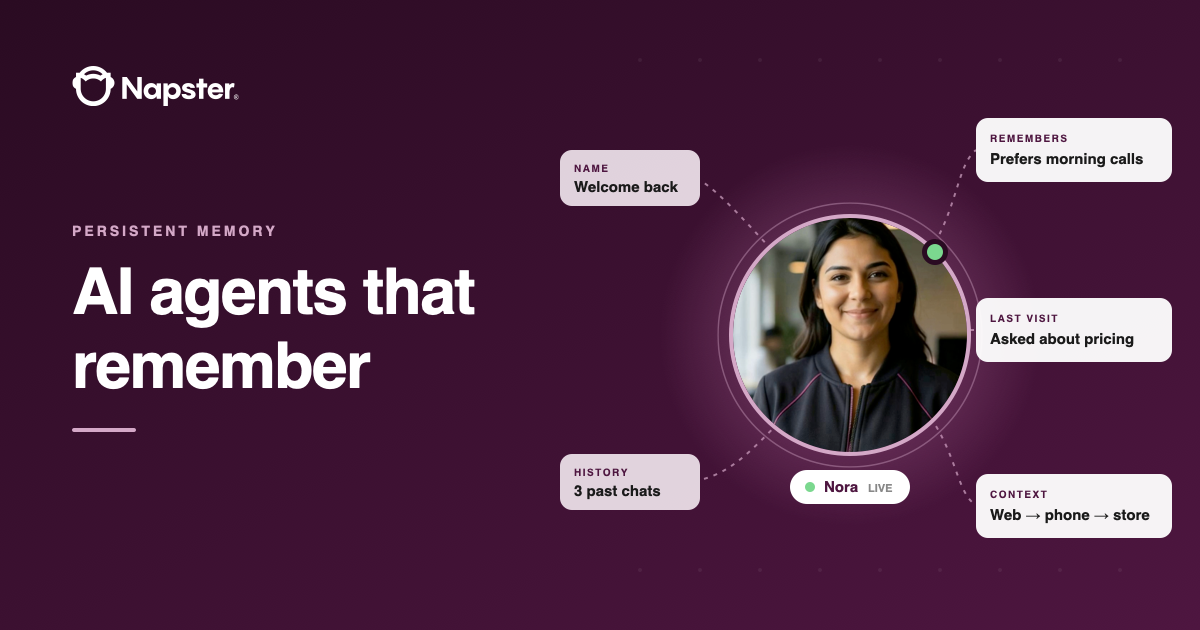
Persistent memory is the difference between being another business with a shiny AI tool and one with real customer value. With an agent that remembers her, that customer gives her loyalty number at the counter instead of returning to step 1. And the agent already knows which machine she chose, which ones she ruled out, and why. She’s out the door with her new machine and a memorable customer experience, in five minutes flat.
How does AI agent memory work?
Most AI agents work inside a single conversation. They hold context while the session is open, and when it closes, everything the customer said goes with it. Persistent memory turns the highlights of each interaction into cues for next time and ensures that a customer doesn’t have to repeat their preferences repeatedly.
Depending on how a business configures an agent’s memory, it can store a past purchase or an open issue, then recall it when that customer comes back, whether that’s tomorrow or months down the road. Amazon’s “About You” section for individual shoppers, user roasts notwithstanding, is a surface-level example of what this looks like. This section holds information about a customer stored by a business to better infer what that person likes, what they’re looking for now, and what they’ll need the next time they visit.
Where memory changes the outcome
Good memory is selective. The agent keeps what will help next time and ties it to the right person through a loyalty number or account. Our persistent memory explainer covers the mechanics in more depth, but an essential piece of the equation is that memory is a customer-focused feature. This technology should be used to improve service, not harbor every detail of a person’s latest interaction with your brand. Privacy and responsible data practices matter even more when the tool storing customer information can also infer intent and act.
Memory pays off anywhere a relationship outlasts a single conversation.
High-consideration purchases
These kinds of purchases are the clearest case. Buying a car takes nearly 14 hours of shopping, and buyers visit an average of 4.6 websites along the way, according to Cox Automotive’s 2025 Car Buyer Journey Study. An agent that remembers the budget and the shortlist turns every return visit into the next step.
Luxury retail
Luxury raises the stakes. BCG and Altagamma estimate that top-tier clients, roughly 0.1% of luxury consumers, account for 23% of personal and experiential luxury spending. Their 2025 research also found that 70% of potential top-tier clients aren’t correctly identified by the brands they buy from. Those are the customers a brand can least afford to treat as strangers.
Customer service
Service is another. A customer in the middle of an issue shouldn’t have to recount its history to every new agent, human or AI. Genesys’s 2026 State of Customer Experience report found that 95% of consumers expect their information to be remembered across channels, while 48% of organizations don’t automatically pass information between virtual and human agents. An agent with memory hands a human colleague the full story, so the customer picks up where they left off, gets closer to a solution, and feels heard.
Education
And memory takes centerstage as education systems continue to grapple with how to responsibly implement AI for learning. An AI assistant that doesn’t remember a student’s previous questions about a topic can’t determine if they’re making any progress. Similarly, no one should have to re-explain their strengths, weaknesses, and background before every assessment.
A 2025 study from researchers at Worcester Polytechnic Institute and four other universities tested the effects of memory on AI tutor performance. A tutor that kept a running profile of each student’s strengths and gaps outperformed four other AI tutors, and taking the profile away cut learning gains more than removing any other part of the system. The sessions used simulated students built from real classroom data, so there’s more work to be done on real-world use cases, but it’s a promising result.
When AI agents shouldn’t remember: privacy and selective memory
Plenty of interactions are better off without memory, too. A visitor asking a convention center kiosk where Hall C is wants directions and nothing more. Store hours and return windows work the same way. In the same Adobe survey from earlier, 62% of consumers said they prefer a generic interaction for simple questions. Storing those exchanges adds privacy exposure without making the answer any better.
Memory also has to be earned. Customers should know what an agent keeps and be able to change it, and that data should belong to the customer and the business that deploys the agent.
How to add persistent memory to your AI agents
The customer at the counter will never know which model your store is using. She’ll know whether the agent remembered her and how that changed her experience. So prioritize memory that sticks with your business rather than systems that attach persistent memory to a particular model or vendor.
Persistent memory runs across Napster’s products. Napster Agent, Napster Learn, and the Napster App all can be configured to remember the people they work with, and every agent built with the Napster API has persistent memory capabilities.
That memory sits with your deployment, separate from the AI model that powers it. Models improve quickly, and businesses switch between them as better options arrive. When you switch, your agent keeps every customer relationship it’s built.
Start building an agent that remembers with the Napster API.
Related posts
Stay up to date with the latest platform updates, feature launches, and important news.




Press inquiries.
Journalists and media professionals can contact our team for interviews, information, or additional materials.